The History of a Place called Brafford Store Knox County
Brafford Store Knox County and a Post Office
P D was reported in a 1921 newspaper article as being the first County Judge of Knox County. He lived at Gray until he died in 1875. Parks Brittain was born in 1800 and died in 1875. Brittain’s father, Levi Brittain, was the first Brittain settler to Knox County. Melinda’s father was Pearson Duncan, a huge landowner who also lived at Gray. Brittain and Duncan held 4,000 acres m/l in the Gray area. Melinda’s nephews inherited the estates, their last name being Gray of which the town of Gray gets it’s name. It was first called Gray’s Station after the railroad depot.
A Post Office, a Castle, a Judge, a Law Suit, a Louisville Capitalist and Brafford Store Knox County
Introduction
Brafford Cemetery sets upon a high hill and is lush and green during the beginning in early spring. The area was once called Braffords Store situated in Knox County. The sun beams down upon the gravestones in the summer. The trees are off in the distance and can’t shade most of the plots. The cemetery is very well kept with an overseer and is mowed regularly. There are large empty areas between the new stones and the older ones and one must wonder why this is. It is as if there are two cemeteries that were later merged, and they were.
The new area in the cemetery was once the location of the church. The older area was the cemetery that sat below it on the hill. The newer part of the cemetery was started just before 1906. In 1906, a newer church had been built and as years went by it came to be called Rossland Church, located about one half mile south. Mary Victoria Surgenor Dizney described giving birth to her son. Her son, Edward Dizney, was born while the first church meeting was in session. Edward Dizney was born in 1906.
Brafford Store Knox County
The Rossland Church was donated by the Brafford Descendants. The Old Rossland Church is listed as a Kentucky Historical Site. It bears the distinction of being one of the first historical sites in Knox County to be recorded. It still stands at Rossland but is in dire need of restoration. A newer church has been built on the main road and the old church stands idle.
The old church and the cemetery was at one time the center of a forgotten area once named Brafford Store. Once a thriving agricultural area, little remains of it now. There are two separate cemeteries. There is an old run down church and some forgotten people. The small communities of Gray and Rossland are also here.
Gray and Rossland
Gray Kentucky and the Rossland area surrounding it was once part of a town that was called Brafford Store. Brafford Store had a U S Post Office in the early 1800s. It was located at Alfred G Brafford’s general store. So, it carried his name. A G Brafford was the first postmaster of the area that lay between the Barbourville and Lynn Camp post offices. Lynn Camp lay between McHargue Cemetery and Collier Hill.
Thomas Balton Dizney was the second postmaster at Brafford Store. His wife, Rebecca Donaldson, assisted him. They began their service sometime before 1872. This was after they returned from a trip to California and the gold rush there. Apparently the post office worked as a tavern, general store and a restaurant. Newspaper articles of the time period speak of Rebecca Donaldson Dizney cooking for patrons in the 1880s.
Alfred Brafford was a descendent of Lafayette Brafford. Lafayette was a revolutionary soldier. He gained his plantation from a military grant from Virginia for his service to the nation. Many land grants were paid in this way. The amount of land was based on your rank in service and the length of time you served. Military grants for Virginia soldiers were granted in Virginia’s territory of what would become Kentucky.
Brafford Store Knox County
Early land records reveal that the Brafford Store property and the surrounding area were once part of a vast plantation. This plantation, owned by Moses Foley Sr., comprised at least one to two thousand acres. Moses Foley was a preacher and a founder from the late 1700s into the 1800s. He established many churches in Virginia (Holston River), Tennessee, and Kentucky. He was also one of the early founders of the First Baptist Church in Barbourville. Several of his sons would start churches of their own.
Squire Foley would start one at Indian Creek. Moses Foley J started as a minister at Crab Orchard. Moses Foley Sr. married Elizabeth Green, the daughter of Elizabeth Lauderdale Green. The Lauderdales and Maitlands are the descendants and original owners of the Thirlestane Castle in Scotland. Moses would become his mother-in-law’s administrator and thus had access to huge amounts of capital. Through his descendants, the Foley property would eventually be divided. The different farms were sold or settled by the heirs. The Foley home place became the area called Indian Creek.
The Foley Family Cemetery is located at Indian Creek and it now bears the name “Chance Cemetery”. Winnifred, one of Moses Foley’s daughters, married Pearson Duncan. From that estate, the area of Brafford Store was formed. Parks Daniel “P D” Brittain married one of the Foley/Duncan heirs. He became the cornerstone of the community.
A Judge and Brafford Store Knox County
P D Brittain lived near Brafford Store. He became the first Knox County Circuit Court Judge. He traveled from one place to another, bringing his own staff along and holding court. About 1850, Knox County established the Circuit Court Judge position. This was due to the time it took to travel to Barbourville for court and other business. Brittain married Melinda Foley, granddaughter of Moses Foley. The title Circuit Judge came from “Riding the Circuit.” It was an imaginary circle that covered the outskirts of the county. This practice became customary in the early days.
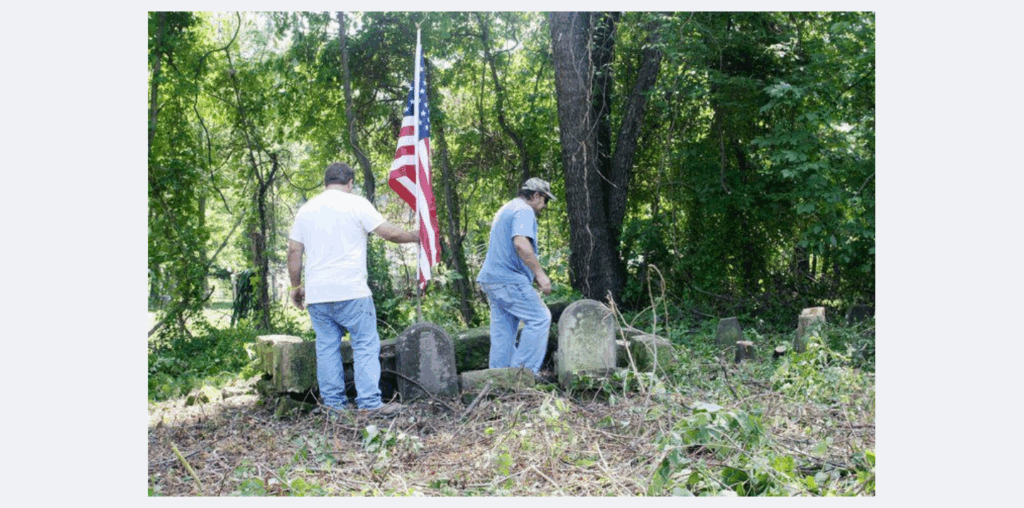
Circuit preachers would do the same thing, traveling from one church to another to have services. P D Brittain was buried at Rossland “Brafford Store.” His grave was soon forgotten. His work for the county was also forgotten. His final resting place was discovered and made known in the summer of 2011. He lies beside his wife Melinda Foley Duncan Brittain in what is now called the Phipps’s Cemetery. The children of the county attorney were a Tidwell. He assisted him in his work. They are buried nearby, a testament to old days forgotten.
P D Brittain’s home place became the first graded school for Gray after Brittain’s death. It was a huge building sitting upon a hill. The hill overlooked his vast estate. Forest Products now sits across the street from where the old school once stood. Parks Brittain was the son of Levi Brittain. He was the grandson of Nathaniel Brittain, a soldier who died along with his brothers in the Revolutionary War. Levi’s brother, George Brittain, is referred to as the “Father of Harlan County”
A Louisville Capitalist and Brafford Store Knox County
In 1883, articles of corporation were filed and recorded for The North Jellico Coal Company at Rossland. The officers were James Breckinridge “J B” Speed of Louisville, W. N. Culp of Louisville, John P Byrnes of Louisville, William E. Grinstead of Louisville, A. P Speed of Louisville, Ansil Gatliff of Williamsburg and Green A Denham of Williamsburg. J B Speed and John P. Byrnes were owners of a coal shipping yard on the Portland Canal in Louisville. J B Speed held many companies including one of the first cement plants.
Speed was an owner of what would become Louisville Gas and Electric. His relative was the United States Attorney General under Abraham Lincoln during the Civil War. Speed’s family was instrumental in keeping Kentucky from joining the ranks of the Confederates. Speed Hall is named for J B Speed for his donations there. J B Speed’s wife also donated money to Union College in Barbourville and Speed Hall is part of their campus. Speed’s estate started the Speed Art Museum in Louisville. Speed’s son-in-law would become an officer for the company later on. He would soon leave after becoming an ambassador to Germany.
North Jellico Coal Company
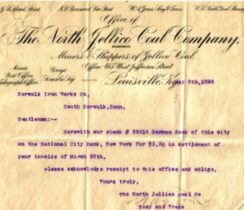
W. N Culp was an L& N Railroad executive. William E. Grinstead was an investor in the tobacco market among other things. Ansil Gatliff started Cumberland College and the Bank of Williamsburg during his career. The formation of the corporation started a huge community near Gray and at Rossland and Indian Creek. In 1883, the company began buying land extensively. This buying spree would be worth about 4 billion dollars in today’s dollars.
The mine at Bertha and Wilton were state of the art. They had an electrical plant for power. Air compressors powered machinery. Electrical powered rail cars hauled the coal to the mining tipples. The mine was unionized. It provided their employees and families with a commissary, churches, housing, and a paycheck. A doctor was provided. Separate schools for white and colored children were available. Most of the other comforts needed for survival were also supplied. The camp had an IOOF lodge and was eventually made a voting precinct. A railroad spur was brought in on the south boundary and north boundary.
Remnants of the Past
These were good times for a land that had struggled for many years. The mining camp was worked out. James Tillman Gray, a son of the founder of Gray Kentucky, took over. He worked at what they would call “Robbing the coal”. This was a term used for cleaning out the last remains of the leftover coal. These were the dangerous times for coal mining.
The only remnants of the old camp today is a cemetery that is almost completely overgrown. It is difficult to access. There are a few homes that set at the entrance of the mines. Some memories also stay but they fade each day. A law suit would cast doubt upon the proper ownership of the first settlers of Gray proper. Upon Melinda Foley’s death, the bulk of her estate went to her sister’s son. William Gray’s child received it, and his grandmother administered it until her death. Winnifred once tried to change the will which would cause some problems later on. The Gray descendants established a town which was named Gray after Colvin Gray.
Brafford Store Knox County and Gray Ky
Melinda inherited her immense estate from Pearson Duncan. She cared for him, his wife, and her mother, Winnifred Foley Duncan. Melinda and her sister were stepchildren of Pearson Duncan, but he claimed them both as his daughters. The deed executed on his death was recorded, but only part was recorded and handed back to her. Only after P D Brittain died would the unrecorded rest of the deed be found. All these factors led to a lawsuit being filed around 1900.
The lawsuit aimed to prove the legitimacy of the deed and paternity. It also sought to find out if a part of a recorded deed was legitimate. Additionally, it sought to find out if a brother was entitled to any estate.
At one time, there was concern about the legality of the lots sold in Gray proper. This issue threatened to put the community in jeopardy. This was settled in court but was re-filed again in appellate court. The final court proceeding held the first judgment to be proper. Gray began to thrive from that time on. The downturn in coal sales would later bring it to where it is today.
Conclusion on Brafford Store Knox County
The town of Gray has had its ups and downs over the years. At times, the existence of the town itself has been questioned. Nonetheless, it has always bounced back. Ghost towns exist around her and have come and gone several times while the hills whisper their silent secrets. You just have to take the time to listen closely if you want to hear them. People have come and gone in our community. Many of their accomplishments and struggles have been forgotten. Lest not that we forget.
Brafford Store Knox County
Author, Marty Lain Wyatt
Brafford Store Knox County