The Lynn Camp Myth
Lynn Camp and Lynn Camp Station:
Early Settlement and Corbin
Where it Happened
As Kentucky counties took shape and land settled, towns and villages that once flourished disappeared. They left only traces of where they once stood. To understand the hints that are there while researching these records, one must pay close attention. Focus on the factors that shaped these areas. Little things can give insights, like old maps showing where roadways and railroads navigated. These maps will give a researcher a better picture of what things were “back in the day.”
Names wordings are crucial. Information on census records, post office personnel’s names, and taverns’ locations also play critical roles in discovering true meanings. Lynn Camp is one village that taunts a researcher with double talk and mysterious clues. Thanks to a gentleman named John “J. K.” McClary and a Civil War event that happened at Lynn Camp in 1862 the story comes to life. Further research also documents Lynn Camp’s true location.
Corbin
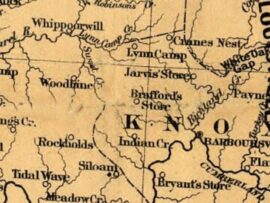
Corbin has been described as the original location of the town of Lynn Camp but this is incorrect. The area that would make up Corbin was known as Lynn Camp Stations or simply Lynn Camp after 1870. This was because Lynn Camp’s Post Office ceased to exist after the Civil War ended. It closed sometime after 1880. The exact starting date of the post office at Lynn Camp is uncertain. Yet, it was noted on a map in 1839. This map was drafted by the postal service as a mail stop over point.
The post office of Whippoorwill near Corbin was located in Laurel County based on postal records. Further confusion about Lynn Camp’s location was the fact Lynn Camp was also an election precinct in the early years. The precinct took in the area east of Woodbine as well as northern Knox County to very near Barbourville.
The northwest county boundary between Knox and Laurel County has been moved three separate times. This was to include Lynn Camp in Knox County at one time period. Later, it was moved to include Lynn Camp into Laurel County. This county transfer see-sawed back and forth about four times.Lynn Camp’s location is important because it gives a clue to the location of where sixteen Union Soldiers were imprisoned.
Civil War Prisoners
A group of Confederate Militia had arrested them for killing some marching soldiers belonging to the rebels. Lynn Camp is among some of the earliest settlements. It is the site of a very early tavern and post office. Lynn Camp ranks along with Flatlick and Stanford, to list a few.
Lynn Camp lay close to the Wilderness Road. It was between Woodbine to her southwest. Barbourville lay to her southeast. There was also a forgotten place called Raccoon Springs to her north. Raccoon Springs was near Campground in Laurel County and is on maps dated 1793. The Post Office was simply called Raccoon.
Collier House (Tavern) was located on 233 at Gray on Collier (Colyer Hill). Location of a Tavern, Livery, Stockyard and boarding house in the 1800s. Our version of a motel of today. (Courtesy of Ada Gilbert). Taverns were the focal points for traffic and the center of the villages. They offered food, lodging, general merchandise and supplies and mail service. The taverns offered liveries for horses and their carriages as well as feed and water for the horses.
Many taverns had fenced lots to put livestock in pens for farmers taking stock to bigger markets. Taverns were usually spaced about ten miles apart. Roads were rough at best and traffic averaged about one to two miles an hour.
Ten miles would be about one day’s travel and taverns were used as stop-overs as well as stagecoach stops. The owners of the taverns were usually financially well off. They would also become wealthier later because of trading and the lack of competition. Many taverns were used for public meetings.
The Collier House
The tavern owner at Lynn Camp in 1850 was Stephen Colyer. Collier Hill at Gray carries the legacy of his family and descendant’s name sake. In 1850, according to United States Postal Service, Stephen Colyer, born in 1814, was the postmaster of Lynn Camp. Stephen “S D” Colyer came from Rockcastle County, the grandson of John Colyer.
John was a revolutionary soldier from Virginia according to his wife’s application for a pension. Stephen purchased his property from Samuel Ward, born 1826, and Elizabeth McHargue Ward of the McHargue Church area (McHargue’s Mill’s).
The property bought by Colyer had been part of Samuel Ward’s mother’s estate. It is unclear if Colyer bought the tavern or actually built it afterwards. Stephen operated his tavern himself until his death. Olivia, his wife, operated the tavern until the property was transferred to her children. The property was sold to James Tillman “J T” Gray after Olivia’s death.
A county sale shows Hugh H. Colyer, son of Stephen Colyer, as a plaintiff in a judgment that resulted in its sale in 1910. The deed description on the court auction indicates the starting point of the property. It began at the Hazel Fork branch of Lynn Camp Creek. This was where the bridge crossed the creek. In 1860, Colyer’s boarding house welcomed a gentleman. He would later become well known in his native town of Mt Vernon in Rockcastle County.
Civil War Event Lynn Camp
In 1862 and ten miles from Barbourville, a group of sixteen Union Soldiers were held as prisoners. This was along the Old Wilderness Road. They were accused of bushwhacking a band of Confederate Soldiers marching through the area.
The group was being accused of hiding in the woods while shooting and killing the marching “rebels” marching by. The group swore their innocence of the crime. The rebels had been coming to the store at Lynn Camp and getting food. They had consumed almost all the food available there.
McClary Relations
One of the prisoners was McClary’s relative uncle George “Hog Eye” Thompson. Some of the other prisoners were Harv King and his sons. Another prisoner was Campbell Damron from Somerset who was an uncle to the Langford Boys of Mt Vernon. The Langfords were well known in Rockcastle County and their relatives ran the first tavern in Mt Vernon.
George told McClary at his store that they had not eaten in several days and were starved. Later on that day McClary raked up what was the only food available which was some cornmeal and potatoes.
He cooked them up and placed them in baskets for delivery. McClary had received permission to visit the prisoners and took a black servant from Mrs. Colyer’s tavern by the name of James Colyer to help him.
Robbers Hill
Both men embarked one mile south of Colyer’s Tavern to the prisoner’s camp at “Robber’s Hill” about midnight. They met no resistance as they found the prisoners asleep. After awakening them, the prisoners ate all the food presented to them. The prisoners then bragged “that it was the sweetest bread and Irish Potatoes they had ever eaten”.
McClary then held about a one hour conversation with them mainly because he related he would ever see them again. He departed and went back on his way to the tavern. He would see his uncle a few days later and find out their fate.
Hog Eye Thompson said they had all been shot at “Cumberland Ford” or Pineville as we know it today. Thompson was released and would move to Missouri, returning every year thereafter to visit his family in Kentucky.
It was rumored that Harv King’s brother along with some others hung six Confederate Soldiers. They were hung as revenge for his brother’s death who had died hanging from a tree. The incident happened close to the Hackney Tavern at Livingston.
McClary Impact
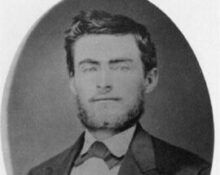
J. K. McClary would serve as deputy sheriff in Rockcastle County under the term of Sheriff Lewis. He was elected a State legislator for one year. He also served for many years as master commissioner of Rockcastle County. McClary served as an attorney at Mt Vernon, trying some cases in Lincoln County as well.
Before all his later accomplishments, McClary would make an appearance in Knox County and leave a mark on history. Mr. McClary and J. R. Joplin, both men of Rockcastle County, operated a store in the Colyer Tavern at Lynn Camp during the 1860s. In 1862, he met with some Union Soldiers. This meeting would intrigue Civil War researchers for many years to come.
Lynn Camps Stephen Colyer worked as a Tavern Keeper according to the census records of 1860 . Stephen married his wife who was listed as Olivia according to the census. At the bottom of his household is a black male by the name of John Colyer, all collaborating Mr. McClary’s story.
Census records from 1860 show Stephen Colyer owning seven slaves. Ada Gilbert resides north of Gray at Collier Hill. She now lives on a part of the one hundred sixty acre plantation. This is where the tavern once stood. She has furnished a very early photo of the tavern and staff. The old cemetery sets across the field from her home on a hill.
Corbin Verses Lynn Camp
The railroad did not run through the area that is now Corbin until the Cumberland Branch was added. This branch came in from the east in the 1880s. Early on, the town or city of Corbin was called Lynn Camp Station.
Lynn Camp Station served as a train stop next to Lynn Camp Creek. Lynn Camp allowed the North and/or Southbound steam engines to take on water. Only later in the 1880s would it be called Lynn Camp after the Lynn Camp post office was gone.
Lynn Camp in some instances was chosen to be called the Lynn Camp Stations. The plural indicates more than one station, probably signaling another station close by. Corbin properties sold during the rush years were called “at Lynn Camp Park”.
The postmasters of Lynn Camp chose to live north of Gray close to the Laurel County line. The timeline dictated for this dates from the 1830s until at least ten years after the Civil War ended. They lived very near McHargue Church. The Lynn Camp area comprised a small town with a post office.
It also had one of the earliest taverns that existed in northern Knox County. This deserves credit as a very historical place in Knox County History. The credit is both for the age and significance of the early tavern and because of the Civil War Event. Now on to find the place once called “Robber’s Hill”. I don’t know, maybe tomorrow? █
Neighboring Towns
The maps of the 1860’s show the railroad completely bypassing Woodbine and Corbin. It runs north to south but is some miles west of Woodbine and Corbin area. It is also far from the town of London. The old wagon roadway ran north to south through Woodbine. It bypassed Corbin to the east. It also bypassed Lynn Camp with three roads converging at Raccoon Springs.
The other roadway (Old Barbourville Road) went from Cumberland Gap to Flatlick. Then, it continued through Barbourville and Lynn Camp to Raccoon Springs. Raccoon Springs had four roads converging near Laurel River suggesting a major bridge across the Little Laurel River. Along these roadways, the small villages were often locations of taverns. The post office was usually there as well.
Knox County Kentucky History and Genealogy on Facebook
Author: Marty Wyatt
Join us on Social Media