Kentucky Settlement during the Revolution and the impact of Ky Indentured Servants
Your Ky Indentured Servants

Bridge to Revolutionary War monument, Concord, Mass
Courtesy of the Library of Congress Digital Collections
Introduction
A very fascinating and misunderstood part of Kentucky genealogy and history research are the Revolutionary War Veterans. Many researchers track their descendants. They will come upon an individual who once lived in Virginia or Pennsylvania. Others hail from North Carolina or another colony. Everyone asks themselves the same question, “What in the world brought them to Kentucky”?
Their birthdate gives evidence. This is because they are usually born between about 1735 and 1760. These birth dates are important. They align the individual to be the right age to serve in the Revolutionary War during the time period.
The Revolutionary Veterans are an essential and rewarding part of your family tree. The research involves many aspects, perceptions, and ideologies of this early time period. These will explain a lot of why they did what they did. Many of the reasons are heartfelt and heartbreaking. They originate from common practices and notions from a bygone time.

Courtesy of Library Of Congress
Ky Indentured Servants
Why They Came to America
There were a few reasons our colonial veterans, or their lineage, came to America. Some of the reasons were religious beliefs and lack of work. Others included poverty, discrimination, and wars. Britain’s philosophy that the impoverished should be used for migrant work needs was also a factor. Famines, a potato famine in particular, drove migration. Additionally, the prospect of owning your own land was attractive. Criminal and political crimes motivated others. And last but not least, primogeniture played a significant role. We will discuss the primogeniture reasoning in this article. So what is primogeniture?
Ky Indentured Servants
Primogeniture
Primogeniture (English: /praɪməˈdʒɛnɪtʃər/) is the right, by law or custom, of the paternally acknowledged, firstborn son. He inherits his parent’s entire or main estate. This occurs in preference to daughters, elder illegitimate sons, younger sons and collateral relatives. In some cases, the estate was to be the inheritance of the firstborn child. This will occasionally be the firstborn daughter. The descendant of a deceased elder parent inherit the estate. This is passed down to the elsest before a living younger sibling is considered.
This is by right of substitution for the deceased heir. In the absence of any children, brothers succeed. This is done by individuallity, to the inheritance by seniority of age (conditional to substitution). Among siblings, sons usually inherit before daughters. If there are no male descendants in the male-line it creates a new process. Some variations of primogeniture assign the inheritance to a daughter. Others assign it to a brother. In the absence of either, to another collateral relative, in a specified order. (e.g. male-preference primogeniture, Salic primogeniture, semi-Salic primogeniture).
The principle has applied in history to inheritance of real property (land). It will also extend as well to inherited titles and offices. This is most notable in monarchies. It continued until modified or abolished.
Ky Indentured Servants
Primogeniture in Europe
Variations on primogeniture change the right of the first-born son to the entirety of a family’s inheritance. In the West since World War II, remove the preference for males over women (absolute primogeniture). Most monarchies in Western Europe have eliminated male preference in succession. These include Belgium, Denmark, Luxembourg, Netherlands, Norway, Sweden, and the United Kingdom.
The law of primogeniture in Europe has its origins in Medieval Europe. The feudal system necessitated that the estates remain united. The land-owning feudal lords ere to be kept as large and united as possible. This was done to preserve social stability as well as the wealth, power, and social standing of their families.[10]
Ky Indentured Servants
Estates and Impacts
Adam Smith, in his book An Inquiry into the Nature and Causes of the Wealth of Nations, explains the origin of primogeniture in Europe in the next way:
Land was not merely a means of subsistence. It was also a source of power and protection. Thus, it was thought better that it should descend undivided to one. In those disorderly times, every great landlord was considered a petty prince. His tenants were his subjects. He was their judge, and in some respects their legislator in peace and their leader in war.
He made war according to his own discretion, often against his neighbors, and sometimes against his sovereign. The security of a landed estate needed its greatness. So, a landowner can only protect those who dwelt on it if it was a large estate. Dividing it would lead to its ruin. Each part would easily be oppressed and swallowed up by neighboring incursions.
The law of primogeniture, thus, took place gradually in the succession of landed estates. This occurred for the same reason it generally happens in monarchies. Nevertheless, it does not always happen at their first institution.
The policy of inheritance remained intact in many instances even up until WWII. This was clear in FDR’s response to Winston Churchill. When Winston Churchill and Franklin Roosevelt met at Placentia Bay in August 1941, FDR expressed confusion. He couldn’t understand the British aristocracy’s concept of primogeniture. He intended to divide his estate equally between his five children. Churchill explained that an equal distribution was nicknamed the “Spanish Curse” by the British upper classes. He stated, “We give everything to the eldest. The others strive to duplicate it and found empires. While the oldest, having it all, marries for beauty. Which accounts, Mr President, for my good looks” (1)
Ky Indentured Servants
Primogeniture and Wikipedia’s Interpretation
{1. Primogeniture on Wikipedia, “The original work has been modified.”; LINK of Original }
The inheritance by the eldest son or child created descendants that inherited very little. This made the promise of a better future in America be a better opportunity for these non-inheritance.
The vast majority of eventual settlers worked and toiled everyday on property that was owned by a Lord. They owned nothing and the Lord took a part of their labor for his protection. The Irish residents were no better off in their arrangements. They owned none of the land they tended and were forced to rent everything from their landowners. If the renters improved the farms, the rent would increase. The landowner was renting to the Irish farmer. Very little was done as far as improvements on the rental properties.
The prospect of owning land was enticing. The ability to grow more food to feed their family made it even more appealing. This was the most tempting promise that would convince settlers to come to the colonies. Indentures to pay for the fare of a ship put people in a type of bondage. Still, this was a convenient way to move them out of the despair they were living in. Many took the offers, gave up what little they had, and made the voyage to America.
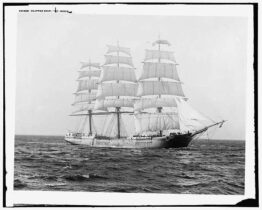
Courtesy of Library Of Congress, Clipper Sailing ship
Ky Indentured Servants
.
How They Got to America and at What Cost
Settlers, for the lack of a better definition, came to America in different ways. They arrived under various circumstances. Their reasons varied, and they came in several ways. Some came as slaves. Some were political prisoners.
Yet, the biggest majority of colonists migrated as indentured servants, which was a type of bondage. It is the latter of these that we will detail.
To get passage to America it would have been by ship. The ships would transport people coming to America and their ship passage would be owed. The passengers would sign a contract of indenture for the cost of coming “across the pond”. The passengers would then owe a debt for this money. The owner of the indenture would sell the debt to someone in need of labor in the colonies.
When the passengers arrived at their new home in the colonies, the plantation or land companies purchased their indebted contracts. The indebted person was obligated to work for a specific length of time, usually five years. They had to work for the owner before they were freed from their debt and contract.
Ky Indentured Servants
Overview
No wages were paid but only to satisfy the debt. The owner of the contract was expected to give food, housing as well as clothing to the indentured servants. The owners were also expected to teach them a trade. Farming was the usual trade taught to a huge majority. At the end of their contract they were free to go. They would choose as they wished. Usually, they left with a small piece of property.
Most settlers to America originally came as indentured servants. They worked off their contracts over years to become free landowners. An estimated sixty five percent of the Revolutionary War veterans enlisted as soldiers. They joined the Revolution to be freed from their indentures.
Ky Indentured Servants
The Revolution
There is more than one reason for the Revolutionary War. Still, most agree that the colonists expected a voice in the laws enacted for the colonies. The colonists also hated taxes especially when they had no voice in deciding them.
They wanted protection. Yet, they were indifferent when taxes were placed on necessities they used every day. Sugar and tea were examples of these necessities. Some colonists felt the King had the right to make laws.
They believed no one else had that right. They felt as though they had no representation in the process. As the wish for independence from British control gained ground, a division had already begun among the colonists. This division would later create a split in loyalties. Some colonists favored independence from Great Britain. Others wished to stay loyal to the Crown.
Many colonists wanted to stay faithful to the monarchy. Many attempted to do so and became referred to as Loyalists, Tories, or King’s Men. Tories came from the old tradition of Tory, a political belief of loyalty to ancient traditions. Tories believed in God, King and Country. They considered themselves part of the Royal Crown. They did not want independence like the other colonists did.
The British often looked down upon them because they were uncertain of their loyalty. Britain’s inability to protect them led very few to support the British. After the war many of these loyalists were awarded for their service by receiving land in Canada. Many of the southern loyalists fled to Florida. Louisville Kentucky was at first deeded to a Loyalist. The town was laid out and began to be established. Yet, he lost possession of the huge land grant because of his political leanings. His support of the British was the reason.
The Patriots were citizens who supported the cause of the Revolution and often discriminated against the Tories. The colony rewarded the Patriots for their service. They acquired land grants called military patents. These were given in the territories of the colony they had served. The colony they had served would decide the location of their land grant. Virginia owned the territory of Kentucky and military patents (Land Grants) were surveyed in what would become Kentucky.
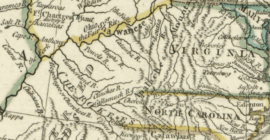
Courtesy of The Library of Congress, Digital Collections Virginia and her territory in 1776
Ky Indentured Servants
Virginia in the Revolutionary War
As you can see in the map above, Virginia included all the territory of current-day Virginia. It also covered what is now Kentucky and West Virginia. During the war, a continuous group of soldiers was needed for battle. To achieve this, there had to be ways to encourage young able-bodied citizens to enlist. They also needed to stay in service. The government’s at that time existed in such a manner that the federal government had very little power. The power was vested in the colonies.
The colonies would supply troops as needed. Still, they were reluctant. For instance, Georgia hesitated to send troops all the way to New York to fight. It seemed far away and of no importance to Georgia. The soldiers were eventually recruited by buying out their indentures. When their service ended, the soldier was given a piece of property. If the contract was fully paid up, the indenture was considered paid.
Virginia gave that property to the soldier in what is now Kentucky because it was their territory. North Carolina gave land in what is now Tennessee and the other colonies did the same with their territories. That is what brought these veterans to Kentucky.
Ky Indentured Servants
Conclusion to Ky Indentured Servants
The early volunteers served in the Virginia Militia and received their military patent in Kentucky. They earned the land grants by serving the militia. As a result, they “paid off” their indentures with their military service. They became free landowners in return. To make sure the claim wasn’t lost, a house needed to be built. A garden also had to be planted to “stake the claim.” It is estimated that sixty five percent of all Revolutionary War Veterans were indentured servants.
There are records that exist for these veterans and are a very useful part of genealogy research.
Ky Indentured Servants
Join us on Social Media